
The LinkyThinks Blog
Tips, ideas and strategies to help your child at home, at school and beyond.
Join the LinkyThinks Parent Guidance WhatsApp group using this link here 👈

Two simple ways to help a reluctant reader
If you’re the parent of a reluctant reader, you’ve probably tried all sorts of things.
Recommended reading lists.
Gentle encouragement.
Less gentle encouragement.
Bribery disguised as “motivation”.
It can be frustrating, especially when you know how important reading is for vocabulary, comprehension, writing and confidence.

Why your child’s struggles might feel so familiar
One of the hardest things about supporting your child is that sometimes their struggles look horribly familiar.
Your child loses track of time, forgets where they put things, struggles to focus unless they’re genuinely interested in something, finds certain social situations confusing, draining or difficult to read.
Maybe you’ve spent years feeling the same way, even if you never quite put it into words.

Advice to parents of reluctant readers
I have a confession to make…
I was never a strong reader.
I enjoyed reading and I was ‘good at it’ (whatever that means), but I struggled to find books I enjoyed and often gave up on recommended reading.
My older brother, however, was a voracious reader. So was my best friend. They devoured books like chocolate cake and, although I liked the idea of getting lost in a novel, the disappointment at failing to be meant that I dubbed myself a ‘bad reader.’
I managed to discover my love of books later in my teens, after breaking a few rules and finding my own way into it.
While the benefits of reading are widely known, it’s never been harder to encourage children to read.

The verbal reasoning mistake children always make
One of the most common traps in 11+ verbal reasoning is surprisingly simple.
Most children understand the basic idea of synonyms:
big = large
quick = fast
silent = quiet
But verbal reasoning questions are designed to test precision of thinking, not just general understanding. And that’s where associated words start causing trouble.

The problem with flashcards for vocabulary
Flashcards can be useful.
They’re good for introducing new words in a manageable way. They’re good for testing whether a child recognises a definition.
But here’s the issue.
The real learning doesn’t happen at either of those points.
It happens in between.

The words you use shape the world you see
Vocabulary isn’t just about sounding clever in an exam.
It shapes how we experience the world.
The words we choose don’t simply describe what’s happening around us. They influence how we interpret it. This idea is known as linguistic framing.
And it has far-reaching effects…

The Verbal Reasoning trap
When it comes to verbal reasoning, there’s one mistake we see again and again.
Children understand what a synonym is. Ask them and they’ll often tell you correctly: two words with the same meaning.
But in the pressure of a reasoning task, something subtle happens. They stop looking for meaning and start looking for connection.
And that’s where they fall into the trap of associated words.
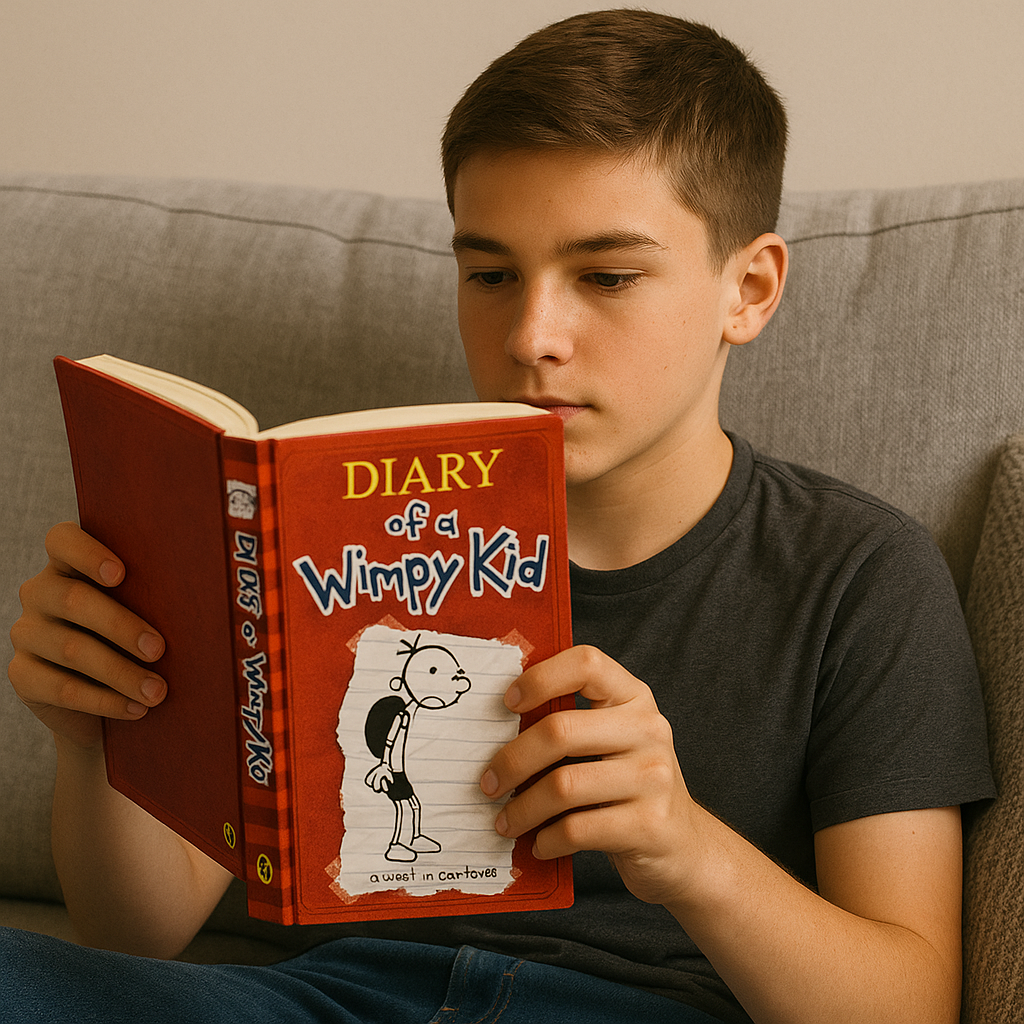
Should your child be reading ‘Diary of a Wimpy Kid’?
One of the questions I get asked most often by parents is along the lines of, “My child only wants to read Diary of a Wimpy Kid (or Dogman/Dork Diaries/Tom Gates). How do I help them read something more challenging?”
This is a really common concern and it comes from such a good place: wanting your child to stretch their vocabulary, deepen their comprehension and transfer these skills into their writing. But here’s the thing: those seemingly ‘easy’ books absolutely do have a place on your child’s bookshelf (and it’s often a more important place than you might think).

How to help a reluctant reader: Six Smart Tips for Parents
Finding it difficult to encourage your child to read? You’re not alone and it’s certainly not a reflection of your efforts. Reading habits are deeply personal. Developing them takes time, flexibility and a little creativity. Here are some practical ways to make the process easier, more enjoyable and far less of a struggle…

Five common myths about building your child’s vocabulary (and what to do instead)
We all want to help our children grow into confident, expressive communicators. But when it comes to vocabulary-building, it’s easy to fall into old traps and tired techniques. Let’s bust a few myths…